

A few weeks ago, I wrote about the global bond rout and how it will ultimately lead to yield curve control (YCC), in which governments around the world resort to outright debt monetization, or digital money creation, to buy back their bonds, support their bond markets, and, so they hope, prevent yields from surging even higher and causing government finances to deteriorate further.
In my report, I argued that yield curve control would dramatically increase the global money supply, causing inflation to worsen even further and, ironically, intensifying the very bond meltdown it is intended to contain. All of this would be highly bullish for hard assets, including precious metals.
After several weeks of relative calm, the global bond meltdown reared its ugly head again today, sending yields soaring to two-decade highs and roiling financial markets across the board, which had been riding high after a week of strong tech stock gains. In today’s update, I’ll show you exactly what happened and how I expect this situation to play out.
Up until Wednesday, the financial markets had breathed a sigh of relief following last week’s Fed meeting, when the federal funds rate was raised by 25 basis points as widely expected. Market participants viewed the move as a sign that the Fed was taking inflation seriously, while also anticipating the possibility of two additional rate hikes by the end of the year.
There was also optimism about a possible U.S.-Iran deal this week, with Iranian President Masoud Pezeshkian visiting New York for the U.N. General Assembly, but the situation apparently deteriorated after Pezeshkian maintained his defiant stance, saying that Tehran would never surrender to the United States, to which U.S. President Donald Trump responded that he could “annihilate” Iran.
Needless to say, energy prices, which had been sinking ahead of the meeting, abruptly reversed higher on Wednesday, with Brent crude oil surging $3.83 per barrel, or nearly 4%, to $103.31. This was one of the main triggers that reignited the global bond rout after a several-week hiatus.
The bond market is highly sensitive to inflation, or rising prices, because it erodes the value of bonds’ fixed coupon payments. As a result, when energy prices spike, bond prices typically sink and their yields rise (learn more in my report), which is exactly what happened on Wednesday, causing great concern across the financial markets.
After flirting with this level in recent weeks but failing to fully surpass it, the U.S. 10-year Treasury note yield finally blasted through the critical 5% level on Wednesday, which has long been viewed as a key line in the sand and one that often triggers panic once crossed.
The 10-year Treasury yield breaking above 5% is particularly significant because the 10-year Treasury is widely regarded as a benchmark long-term risk-free rate in global financial markets and serves as a foundational reference point for interest rates and asset valuations throughout the financial system.
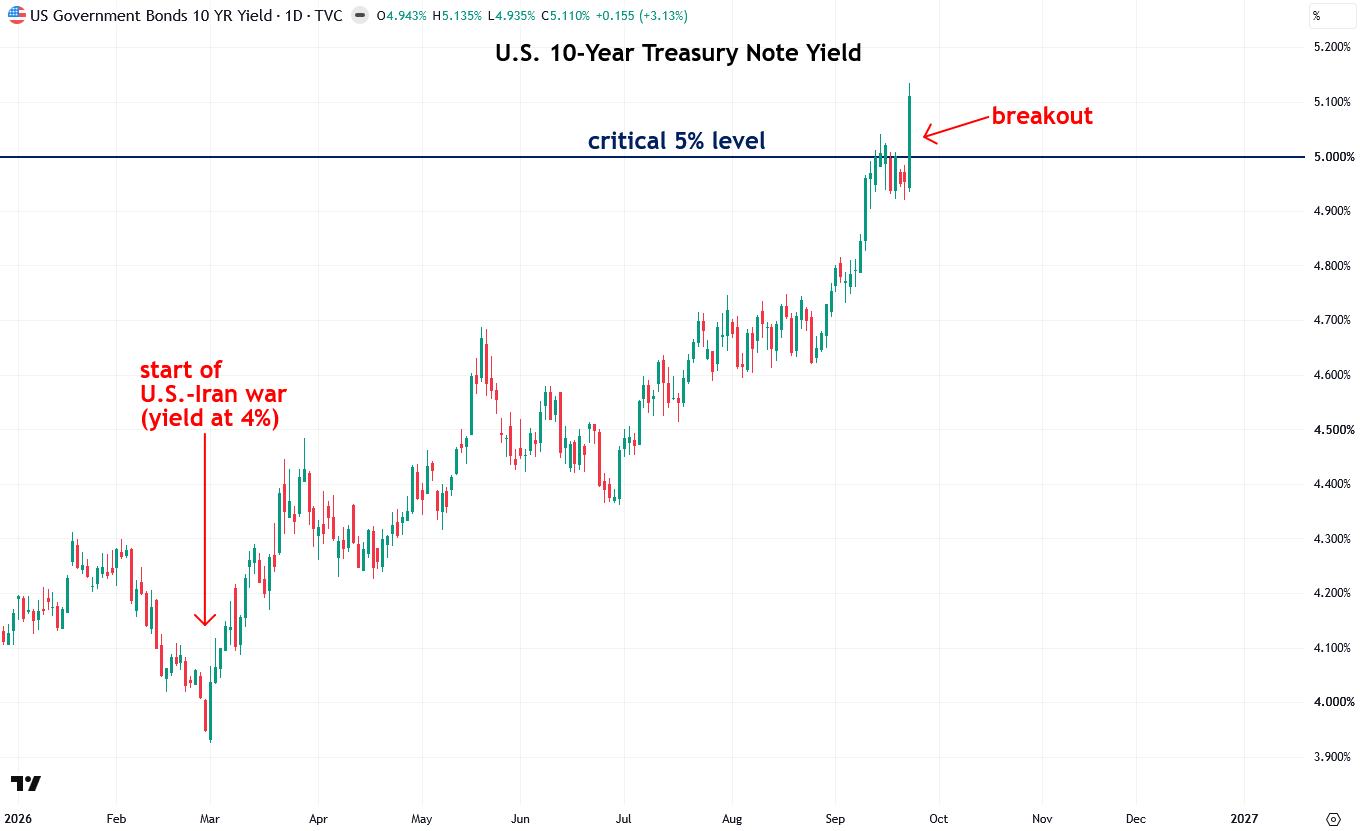
With 10-year Treasury yields now at roughly 5.11%, they are at their highest level since the spring of 2007, shortly before the Great Recession and Global Financial Crisis began and ushered in an era of unprecedented fiscal and monetary stimulus, including artificially suppressed interest rates across the board.